
Reflections from the Writer & Performer of The Last Words of Paul
5/10/25
Even Saints Feel the Cold
By Kelly Ventura
When Paul wrote 2 Timothy, he was nearing the end — not just of his ministry, but of his life. The letter is soaked in urgency, love, disappointment, and defiant hope. And tucked near the end, almost as an afterthought, is a small request:
“When you come, bring the cloak I left with Carpus at Troas…” (2 Tim. 4:13)
It’s easy to skip past that line. We want to get to the “I have fought the good fight.” We want the triumphant finish. But I can’t let go of the cloak.
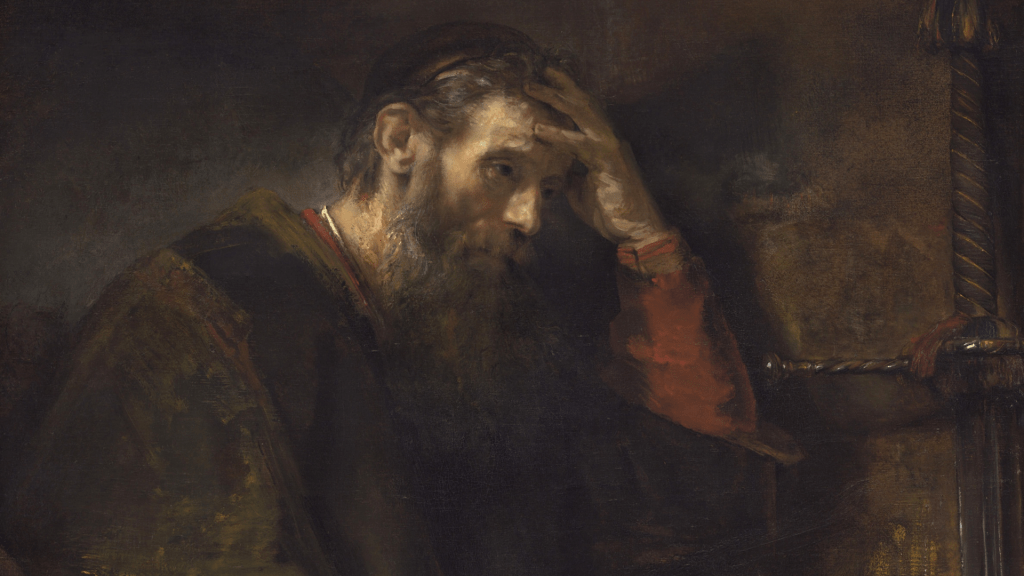
Here is a man who has preached to crowds, healed the sick, written much of what we now call the New Testament — and in the end, he is cold. Alone. Likely shivering in a Roman dungeon, asking for something simple: a garment left behind, a layer of warmth, a bit of comfort.
He knows his time is short. He even says so.
And still… he asks for the cloak.
Even saints feel the cold.
We often want faith to make us immune to discomfort — physical, emotional, spiritual. We assume that strength means not needing anything. But Paul, in his final days, asks for warmth. Not because he lacks faith. But because he’s still human.
That line reminds me that we are allowed to feel our limitations. That the presence of God doesn’t erase our need for human kindness. That ministry and calling and strength can exist right alongside vulnerability.
When I perform The Last Words of Paul, that request for the cloak is often the part that sticks with people — not because it’s dramatic, but because it’s deeply, quietly human. It’s the part that reminds us Paul wasn’t a statue or a stained glass icon. He was a man with a body. A man who got cold.
And somehow, knowing that makes everything he wrote feel even more powerful.
5/4/25
Why Paul’s Final Letter Still Matters
By Kelly Ventura
Of all the letters Paul wrote, none feels more personal than 2 Timothy.
It’s not a theological treatise. It’s not a strategy memo for church planting.
It’s a letter from a man who knows he’s running out of time.
There are no crowds in this one. No missionary journeys ahead. Just a prison cell, a few scraps of parchment, and a heart full of urgency — not for himself, but for the one who would carry the message forward.
That’s why it matters.
Paul isn’t preaching here. He’s bleeding.
He’s not establishing doctrine. He’s handing off a legacy.
And he’s doing it while cold, alone, and facing a death sentence — which makes every word feel heavier, more human, more sacred.
In 2 Timothy, we see the gospel through a different lens — not as a movement to be launched, but as a flame to be kept alive. Paul tells Timothy to fan it. Guard it. Suffer for it. Pass it on. He’s not shouting to the masses anymore. He’s whispering across generations.
And that whisper is still reaching us.
In a culture that prizes speed and platform and certainty, Paul’s final letter reminds us that faithfulness doesn’t always look like winning. Sometimes it looks like enduring. Sometimes it looks like standing firm when the crowd has moved on. Sometimes it looks like writing one last letter, hoping someone out there is still listening.
That’s why I keep coming back to this piece — not just as a performer, but as a man still trying to keep the fire lit.
Paul’s final letter still matters because he meant every word of it…
and because it wasn’t just for Timothy. It was for us.
5/2/25
Holding Faith and Abandonment in the Same Hand
By Kelly Ventura
One of the most jarring moments in 2 Timothy isn’t theological. It’s personal. Paul, the tireless apostle, the firebrand preacher, the one who faced mobs and shipwrecks and prison cells — confesses something we’re not used to hearing from men like him.
“At my first defense, no one came to stand by me, but all deserted me.”
(2 Tim. 4:16)
All deserted me.
We read those words quickly, maybe because we don’t know what to do with them. They don’t sound like victory. They don’t fit our clean categories of what unwavering faith is supposed to look like. But they’re in there — and not as a footnote.
Paul is not vague. He’s not making excuses. He is saying plainly: I was faithful… and still, I was left alone.
And yet — in the next breath — he says this:
“But the Lord stood by me and strengthened me.”
This is the holy tension that most of us don’t know how to talk about:
The ability to hold abandonment in one hand… and faith in the other.
Not resolve it. Not rush through it.
Just hold it.
Paul doesn’t pretend the abandonment didn’t hurt.
And he doesn’t pretend that God’s presence erased it.
He names both. He honors both. And by doing so, he gives us permission to do the same.
There’s something in that for anyone who’s ever been faithful and still felt alone. For anyone who’s followed the call, only to be met with silence, distance, or the ache of absence. For anyone who has walked in obedience and still ended up in a place they never expected.
Paul reminds us that abandonment doesn’t cancel faith.
It doesn’t disqualify our calling.
It simply places us in the company of those who have walked through the fire and kept walking.
Even in that dark, damp Roman cell, he writes.
He hopes.
He blesses.
He still believes.
That’s the kind of faith I want — not a faith that always feels good, but a faith that still holds on when no one else does.
Because sometimes, holding the hurt and the hope in the same hand…
is the most sacred thing we can do.
 The Last Words of Paul